

Introduction
If you own property in Dubai, have a business here, or simply have a bank account — you have an estate. And the UAE has strong opinions about what happens to it when you’re gone.
The default? Sharia inheritance law applies unless you’ve taken active steps to say otherwise. For many expats, that means assets distributed in ways they never intended, families left navigating a foreign legal system in their worst moments, and years of delay.
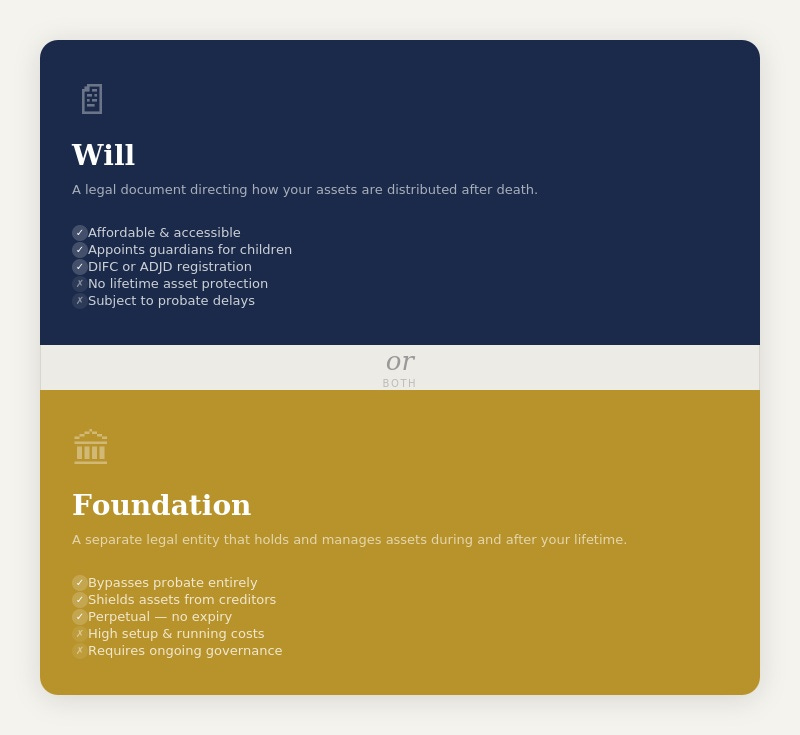
The two most common tools to prevent this are a Will and a Foundation. They are not the same thing. They don’t serve the same purpose. And for many people with real assets in the UAE, the answer isn’t one or the other — it’s both.
Here’s what you need to know.
What is a Will in the UAE?
A Will is a legal document that states how you want your assets distributed after your death. In the UAE, non-Muslims have two primary options for registering one:
DIFC Will — Registered with the Dubai International Financial Centre’s Wills Service Centre. Based on English common law, fully enforceable in English, and since Dubai Law No. 2 of 2025, DIFC wills now have exclusive jurisdiction and direct enforcement for assets located in Dubai — meaning they bypass Dubai Courts entirely. Registration costs approximately AED 10,000 or more.
ADJD Will — Registered with the Abu Dhabi Judicial Department. It costs approximately AED 950 to register and is valid across all seven UAE emirates under federal law, making it the more affordable option for most residents.
For non-Muslims, the law now allows them to apply the inheritance rules of their home country — but only if they’ve registered a valid will in the UAE. Without one, local courts can still fall back on Sharia.
For Muslims, the situation is different. Under Federal Decree-Law No. 41 of 2024, which came into effect on 15 April 2025, Muslim inheritance continues to be governed by Sharia principles unless expatriates explicitly opt for alternative arrangements through a properly registered civil will. A Muslim can still make a will, but it can only direct up to one-third of the estate to non-heirs or causes outside Sharia.
What is a Foundation in the UAE?
A Foundation is a separate legal entity that holds and manages assets independently of the founder. It is governed by regulations including the DIFC Foundations Law No. 3 of 2018, ADGM Foundations Regulations 2017, and RAK ICC Foundations Regulations 2019 (as amended in 2025).
Unlike a will — which only activates at death — a Foundation is a living structure. The founder transfers assets into it during their lifetime, and the Foundation holds, manages, and distributes those assets according to a defined charter and council. The founder can remain involved as a council member and retain significant control.
Foundations can exist indefinitely (perpetual existence), making them ideal for inter-generational planning and family business succession.
Benefits of a Will
1. Testamentary Freedom A will allows non-Muslim expatriates to ensure their assets are distributed according to their personal wishes, without the automatic application of UAE inheritance laws.
2. Guardianship A will is the only legal mechanism to formally appoint guardians for minor children in the UAE. Without it, this decision goes to the courts.
3. Accessible and Affordable The registration process can be completed remotely with electronic signing and witnessing, making it a practical starting point for most residents.
4. Works Alongside International Wills A DIFC Will works alongside a UK will (or will from any home country) as part of a comprehensive international estate plan.
Disadvantages of a Will
1. Probate Delays A will still requires a probate process after death — this takes time, during which assets can be frozen. Bank accounts, in particular, are commonly frozen upon notification of death in the UAE.
2. Limited to UAE Assets A UAE will governs only local assets. For global estate planning, international structuring through trusts or foundations is required.
3. Public Process Probate is a court process — it lacks the privacy many high-net-worth individuals prefer.
4. No Asset Protection During Your Lifetime A will offers zero protection against creditors, business disputes, or claims while you are alive.
Benefits of a Foundation
1. Bypasses Probate Entirely Assets held in an individual’s name are subject to probate, while those held in a foundation are not. This means distribution can happen swiftly and privately.
2. Sharia Override A key advantage of foundations is that courts of the relevant jurisdiction generally do not recognise foreign forced heirship rules for property owned by a foundation in the UAE. This is particularly significant for Muslim residents looking to plan outside of fixed Sharia shares.
3. Lifelong Asset Protection Real estate assets held within a foundation are legally owned by the foundation itself, providing a greater degree of separation from the founder’s personal liabilities and making them less accessible to creditors.
4. Multi-Generational Structure Many global families use UAE Foundations to establish family constitutions, guiding principles, and structured governance that preserve wealth across generations — removing reliance on wills or local inheritance laws entirely.
5. Perpetual Existence A foundation does not expire. Unlike a will, which is a one-time instruction, a foundation governs wealth continuously and adapts as circumstances change.
Disadvantages of a Foundation
1. Cost A foundation may incur higher costs due to its separate legal personality, administrative fees, and ongoing compliance obligations. Setup costs typically start from AED 15,000–25,000+ and ongoing annual fees apply.
2. Complexity Foundations require governance documents, a council, and ongoing administration. They are not a set-and-forget solution and typically require professional management.
3. Not Suitable for Everyone For someone with a straightforward estate — a salary, a single property, minor children — a foundation is often overkill. A well-drafted will achieves the core objectives at a fraction of the cost.
4. Banking Can Be Slower While improving, some UAE banks still require additional due diligence when opening accounts in the name of a foundation, which can slow down the operational side.
So — Which One Do You Need?
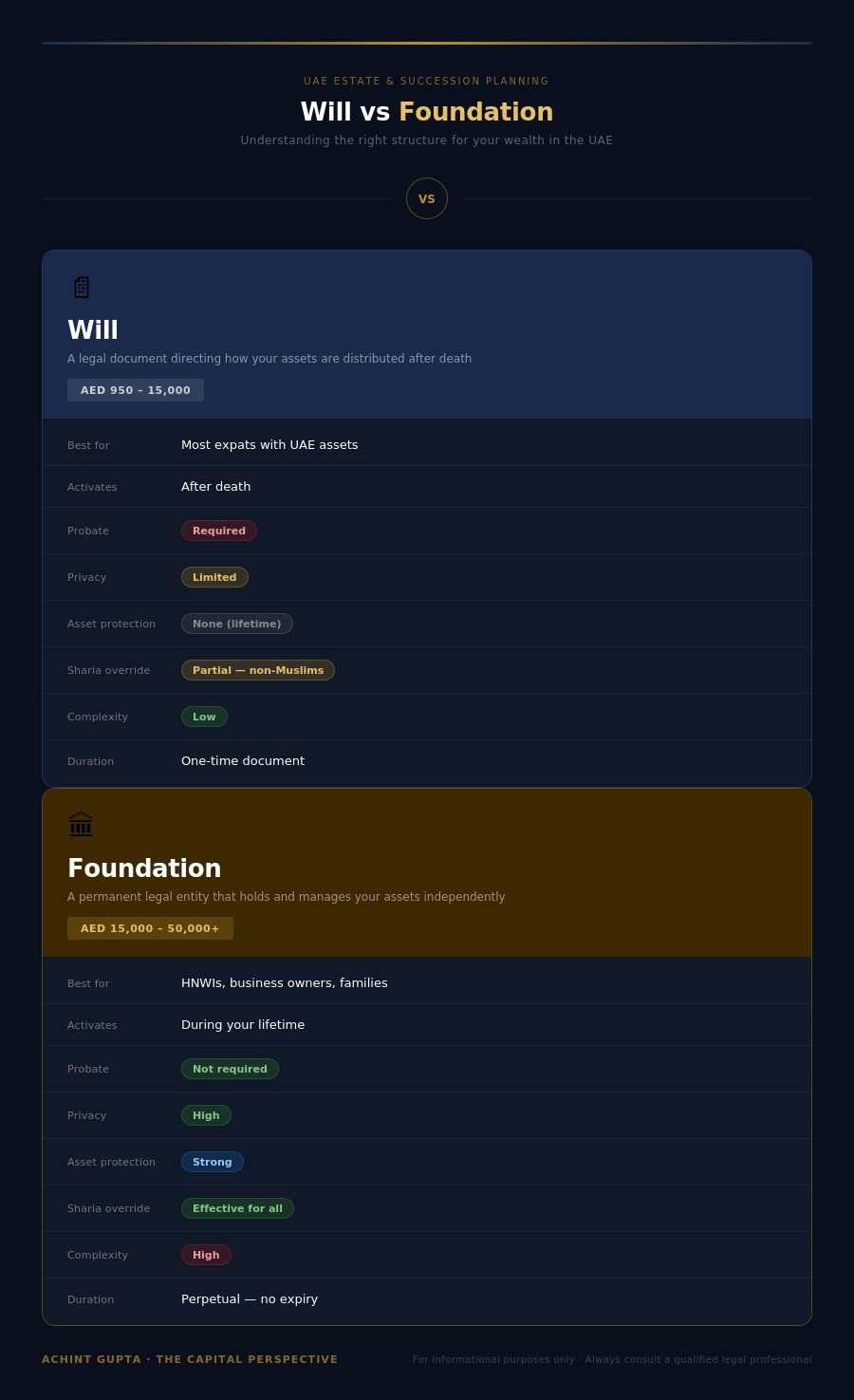
In practice, most expats with significant assets combine both: the will defines who inherits, and the foundation ensures those assets stay managed exactly as planned.
Final Thought
The UAE has built one of the most sophisticated estate planning environments in the world over the past decade. The tools exist. The legal frameworks are modern and enforceable. The question is simply whether you’ve used them.
A will is the floor — the minimum every UAE resident with assets and dependents should have. A foundation is the ceiling — the right tool when the stakes are high enough to justify the structure.
If you’re a property investor, business owner, or someone building long-term wealth in Dubai, the conversation with a qualified estate planning advisor isn’t something to defer. The cost of inaction is always higher than the cost of planning.
This article is for informational purposes only and does not constitute legal or financial advice. Always consult a qualified legal professional for guidance specific to your circumstances.